Estimated Prevalence and Cost of Diabetes
|
Prevalence (1) |
2024 |
2034 |
|---|---|---|
|
Diabetes (type 1 + type 2 diagnosed + type 2 undiagnosed) |
587,710 / 13% |
815,610 / 14% |
|
Diabetes (type 1 and type 2 diagnosed) |
377,410 / 8% |
561,620 / 10% |
|
Diabetes (type 1) |
5-10% of diabetes prevalence |
|
|
Diabetes (type 1 + type 2 diagnosed + type 2 undiagnosed) and prediabetes combined |
1,301,860 / 28% |
1,679,220 / 30% |
|
Increase in diabetes (type 1 and type 2 diagnosed), 2024-2034 |
49% |
|
|
Direct cost to the Health Care System |
$556 million |
|
|
Out-of-pocket cost per year (2) |
||
|
Type 1 diabetes costs, % of family income |
$78-$6,557 / 0%-9% |
|
|
Type 2 diabetes costs, % of family income |
$76-$5,641 / 0%-8% |
|
Impact of Diabetes
- Among Albertans (1):
- 28% live with diabetes or prediabetes;
- 8% live with diagnosed diabetes, climbing to 13% when cases of undiagnosed type 2 diabetes are included.
- Diabetes complications are associated with premature death (3). Diabetes can reduce lifespan by five to 15 years (3). The all-cause mortality rate among people with diabetes is twice as high as for those without diabetes (4).
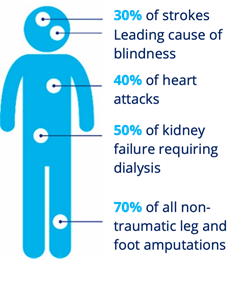
- Diabetes contributes to (5):
- 40% of heart attacks
- 30% of strokes
- 50% of kidney failure requiring dialysis
- Leading cause of blindness
- 70% of all non-traumatic leg and foot amputations
- People with diabetes are over three times more likely to be hospitalized with cardiovascular disease, 12 times more likely to be hospitalized with end-stage renal disease, and nearly 20 times more likely to be hospitalized for a non-traumatic lower limb amputation compared to the general population (3).
- 33-50% of people with diabetes experience diabetes distress (6).
- Individuals with depression have a 40% – 60% increased risk of developing type 2 diabetes (6).
- Foot ulceration affects up to 25% of people with diabetes in their lifetime (9).
- Compared to the general population, adults with diabetes are over 20 times more likely to undergo non-traumatic lower limb amputations, 85% of which are preceded by foot ulcers (10).
- Diabetic retinopathy, a retinal vascular disorder that occurs as a complication of diabetes, is a leading cause of new cases of blindness in Canada, and often affects working-aged adults (7).
- Vision loss is associated with significant morbidity, including increased falls, hip fractures, and an increased risk of death (8).
- Hypoglycemia (low blood sugar) and hyperglycemia (high blood sugar) may affect mood and behaviour and can lead to emergency situations if left untreated (11).
- For people living with diabetes, adherence to treatment is affected by costs which are not covered by their public drugs and devices coverage (2).
- Those with type 1 diabetes can pay up to 9% of their gross annual income on medications and devices that range from $78 to $6,557.
- Those living with type 2 diabetes can pay up to 8% of their gross annual income on medications and devices that range from $76 to $5,641.
Risk Factors for Diabetes
- The risk factors for type 1 diabetes are not well understood, but genetic and environmental interactions are likely involved (11). Type 2 diabetes is caused by a mix of individual, social, environmental, and genetic factors (11).
- Certain populations are at higher risk of developing type 2 diabetes, including those of African, Arab, Asian, Hispanic, Indigenous, or South Asian descent, as well as older adults, those with lower income or education, those who are physically inactive, and those living with overweight or obesity (11).
- Diabetes prevalence rates are 16% among South Asians, 13.3% among Black adults, 12.5% among Arab/West Asians, 8.8% among East/Southeast Asians, and 5.7% among Latin Americans (12).
- The prevalence among First Nations adults off-reserve, Métis adults, and Inuit adults is 1.72 times, 1.22 times, and 1.18 times higher, respectively, than among non-Indigenous adults (12). Colonization continues to impact Indigenous health.
- The prevalence of diabetes among adults in the lowest income groups is 2.1 times that of adults in the highest income group (12).
- Adults without high school education have a diabetes prevalence 1.9 times that of adults with university education (12).
- Social determinants of health such as income, employment, education, and access to health services affect diabetes risk (13).
Policy, Programs, and Services Related to Diabetes
- In December 2024, the government actioned a Diabetes Working Group priority recommendation to expand access to continuous glucose monitoring systems for eligible Albertans 18 years and older.
- In March 2024, the Diabetes Working Group (DWG) submitted its final report with recommendations to inform an Alberta diabetes strategy to the Minister of Health.
- In 2024, Alberta disbanded Strategic Clinical Networks (SCNs), including the Diabetes, Obesity, and Nutrition Strategic Clinical Network (DON SCN) as it refocuses the health care system.
- July 2022, the Minister of Health announced the formation of a Diabetes Working Group with broad representation from Alberta’s diabetes community to deliver recommendations to the government on key priorities to build a comprehensive provincial diabetes strategy.
- In July 2022, the government canceled its plan to make changes to the Insulin Pump Therapy Program (IPTP) that would require individuals to incur out-of-pocket costs.
- In February 2022, the government announced the addition of real-time continuous glucose monitors (rtCGM) for eligible Albertans under age 18.
- In July 2021, the government announced increased coverage up to $2,400 for diabetes supplies in government sponsored programs, including Blue Cross Coverage for Seniors and Non-Group Coverage.
- In December 2019, the government launched its Biosimilars Initiative which introduced changes for adults using insulin. To maintain public coverage, individuals using an originator insulin will be required to switch to its biosimilar.
- In February 2019, the Guidelines for Supporting Students with Type 1 Diabetes was released to offer guidance to provincial school boards.
Challenges
- Alberta faces challenges in preventing type 2 diabetes and meeting the needs of those with diabetes:
- Non-modifiable risk factors include age, gender, and ethnicity (11).
- The median age in Alberta is 38.4 years, with 14.8% of Albertans over 65 (14). Diabetes risk increases with age (11), and frailty among older adults is linked to reduced function and higher mortality (15).
- Adult men are more at risk of type 2 diabetes than women (11).
- Approximately 27.8% of Albertans identify as African, Arab, Asian, Hispanic, or South Asian, groups at increased risk for type 2 diabetes (11).
- There are 284,465 Indigenous people in Alberta, who face significantly higher diabetes rates (16).
- High rates of modifiable risk factors in Alberta include:
- 42% of adults and 48.8% of youth are physically inactive;
- 35% of adults are overweight and 29.7% are obese;
- 33.4% of youth are overweight or obese;
- 16% of adults are heavy drinkers;
- 16.2% of adults have high blood pressure;
- 80.6% of adults do not consume enough fruits and vegetables;
- 8.1% of adults are current tobacco smokers.
- Social determinants like income, education, and access to health care influence diabetes risks in Alberta (3).
Diabetes Canada’s Recommendations to the Government of Alberta
- Implement the Framework for Diabetes in Canada
- Fund and implement a comprehensive diabetes strategy as prescribed by Alberta's Diabetes Working Group (final report 2024) to improve diabetes prevention, screening, management and health outcomes for Albertans.
- Provide equitable access to diabetes medication, devices, and supplies
-
Reduce barriers to access, such as, ensuring high deductibles and copays are not a barrier or burden to access. Ensure evidence-based, personalized diabetes treatments, including newer insulins and type 2 medications, continuous glucose monitoring systems, insulin pumps, and necessary supplies.
- Protect students with diabetes and provide them with an equal opportunity to learn and participate at school
- Implement a mandatory standard of care for students with diabetes that aligns with Diabetes Canada’s Guidelines for the Care of Students Living with Diabetes at School.
References
- Canadian Diabetes Cost Model. Toronto: Diabetes Canada; 2024.
- Diabetes and Diabetes-Related Out-of-Pocket Costs: 2022 Update. Diabetes Canada; 2022.
- Diabetes in Canada: Facts and figures from a public health perspective [Internet]. Ottawa: Public Health Agency of Canada; 2011 p. 126. Available from: Health-Adjusted Life Expectancy in Canada: 2012 Report by the Public Health Agency of Canada - Canada.ca
- Public Health Agency of Canada. Twenty years of diabetes surveillance using the Canadian chronic disease surveillance system. [Internet]. 2019. Available from: http://publications.gc.ca/collections/collection_2019/aspc-phac/HP35-122-2019-eng.pdf
- Hux J, Booth J, Slaughter P, Laupacis A. Diabetes in Ontario: An ICES Practice Atlas [Internet]. Institute for Clinical Evaluative Sciences; 2003. Available from: https://www.ices.on.ca/Publications/Atlases-and-Reports/2003/Diabetes-in-Ontario
- Diabetes Canada Clinical Practice Guidelines Expert Committee, Robinson DJ, Coons M, Haensel H, Vallis M, Yale JF. Diabetes and Mental Health. Can J Diabetes. 2018 Apr;42 Suppl 1:S130–41.
- Flaxel, Christina J.; Adelman, Ron A.; Bailey, Steven T.; Fawzi, Amani; Lim, Jennifer I.; Vemulakonda, G. Atma; Ying, Gui-shuang. Ophthalmology (Rochester, Minn.), 2020, Vol.127 (1), p.P66-P145
- Vu, H. T., Keeffe, J. E., McCarty, C. A., & Taylor, H. R. (2005). Impact of unilateral and bilateral vision loss on quality of life. The British journal of ophthalmology, 89(3), 360–363. https://doi.org/10.1136/bjo.2004.047498
- Packer CF, Ali SA, Manna B. Diabetic Ulcer. Updated 2023 Jul 17]. In: StatPearls [Internet]. Treasure Island (FL): StatPearls Publishing; 2024 Jan-. Available from: https://www.ncbi.nlm.nih.gov/books/NBK499887/
- Armstrong DG, Boulton AJM, Bus SA. Diabetic Foot Ulcers and Their Recurrence. N Engl J Med. 2017 Jun 15;376(24):2367–75
- Diabetes Canada Clinical Practice Guidelines Expert Committee. Diabetes Canada 2018 Clinical Practice Guidelines for the Prevention and Management of Diabetes in Canada. Can J Diabetes. 2018;42(Suppl 1):S1:S325.
- Public Health Agency of Canada. Pan-Canadian Health Inequalities Data Tool, 2022 Edition [Internet]. Available from: https://healthinfobase.canada.ca/health-inequalities/data-tool/
- Prinjha S, Wicklow B, Nakhla M, Banerjee AT. Toward the Goal of Understanding and Tackling the Social Determinants of Diabetes. Can J Diabetes. 2022 Aug 1;46(6):549–50.
- Statistics Canada, 2021 Census of Population.
- Meneilly GS, Knip A, Miller DB, Sherifali D, Tessier D, Zahedi A. Diabetes in Older People. Can J Diabetes. 2018 Apr;42: S283–95.
- Aboriginal peoples in Canada: Key results from the 2016 Census [Internet]. Ottawa: Statistics Canada; 2017 Oct p. 11. Available from: https://www150.statcan.gc.ca/n1/en/dailyquotidien/171025/dq171025a-eng.pdf?st=krvs_yCt
- Statistics Canada. Table 13-10-0096-01 Health characteristics, annual estimates