

Learning to read food and product labels will help you make informed choices.
It’s also a good tool to compare two products to each other in the same category of food to make a healthy choice.
What’s on the label?
There are several areas of the label that provide key information to help you manage your diabetes.
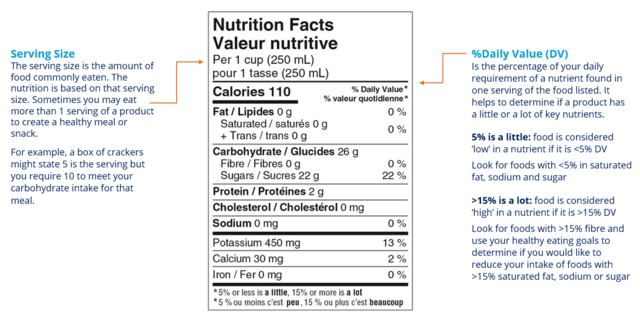
Nutrients of interest
Carbohydrate is the total of all sources including sugar, starch, and fibre. Sugar and starches can affect blood sugar levels. Recommended daily carbohydrate minimum intake is 130 g per day.
- Sugar can be added or naturally occurring. If you don't see the term 'sugars' in the ingredient list, then the sugars listed in the nutrition facts table are naturally occurring.
- Fibre can help regulate blood sugar and improve overall health, so aim for foods high in fibre. The amount of fibre can be subtracted from the total carbohydrates to learn the ‘net carbs’ in the product.
- If you count carbohydrate servings, 15 g is one serving.
- In general look for lower sugar products.
- Recommended daily fibre intake is 25 to 38 g.
Sodium may impact your blood pressure. Many packaged foods tend to be higher in sodium. Look to limit the sodium in food choices.
- Recommended to limit sodium to 1500 mg per day and not to exceed 2300 mg.
Saturated fat can contribute to poor heart health. A food is low in saturated fat if it has 1 gram or less of saturated fat in each serving
- Recommended to be less than 10% calories, or 20 g per day, based on 2000 calorie intake.
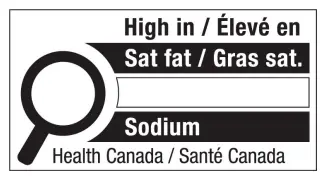
Front of pack labeling
When you see this symbol on the front of a package it means that the food is high in saturated fat, sugar and/or sodium. Foods high in these nutrients are thought to contribute to chronic health conditions such as heart disease, diabetes and high blood pressure. Use the symbol as another tool to help you compare and choose products to meet your healthy eating goals.
Nutrient claims
Just because a food has a health claim does not mean that it is a healthy choice. Certain claims are allowed on packaged food if they meet specific requirements set out by governing bodies. Some key nutrient claims that may be of interest to people living with diabetes include:
Sugar (free, low, reduced)
Products containing little or no sugar can be helpful but does not mean the product is low in or free from carbohydrates.
No added sugar
This claim is appealing but there still may be naturally occurring sugars and the product can still contain carbohydrates.
Fibre (source of fibre, high source of fibre, very high source of fibre)
In general, these are signs the product has at minimum 2 grams of fibre per serving or is a 'source of fibre'. A 'high source of fibre' = 4 g or more and 'very high source of fibre' = 6 g or more.
Saturated fat (free, low, reduced)
Products containing little or no saturated fat can be helpful but does not mean the product is low in total fat or carbohydrates.
Low or no added sodium
Choosing foods low in sodium is a healthy choice but does not mean the product is also low in fat, sugar or carbohydrates.
It is always recommended to consult with a registered dietitian for personalized guidance on managing your healthy eating goals and understanding nutrition labels.
Visit www.diabetes.ca for more healthy eating tips and recipes!