

How to take Injection sites Preparing for injections Types of insulin
What is insulin?
Insulin is a hormone made by the pancreas that helps sugar from the food you eat move from the blood into the body to be used for energy. Without insulin, sugar builds up in the blood leading to health complications. All people living with type 1 diabetes and many living with type 2 need insulin to stay healthy.
When recommending insulin, your diabetes health-care team will think about many things such as your treatment goals, age, lifestyle, eating pattern, general health, plus risk and awareness of low blood sugar (hypoglycemia). There is no “one size fits all” plan.
How do I take insulin?
You can take insulin in different ways. You can choose what works best for you.
Your health-care provider will work with you to decide:
- the number of insulin injections you need each day
- the timing of your insulin injections
- the amount (dose) of insulin you need with each injection
- if an insulin pump will work for you
- your pump settings if you are giving insulin that way
- Insulin pens
- Pens are preloaded with insulin and are easy to use and carry.
- They help give the right dose of insulin at your regular injections times.
- A small needle tip is added for each injection.
- You need a different pen for each type of insulin.
Note: Pens come with an instruction book. Please review it to understand how your pen works.
- Insulin pumps
- Pumps are small devices that replace insulin injections
- They deliver insulin 24 hours a day through a small tube under the skin.
- They respond to your blood sugar readings on your CGM or app.
- The pump is worn outside the body.
- Pumps are often used by people who need many insulin injections each day.
- Syringes
- Syringes today are smaller and use thinner needles.
- Syringes and needles are less costly than pens and pumps.
- Injections are made to be as comfortable as possible.
- If you use two types of insulin, they can sometimes be mixed to reduce injections needed.
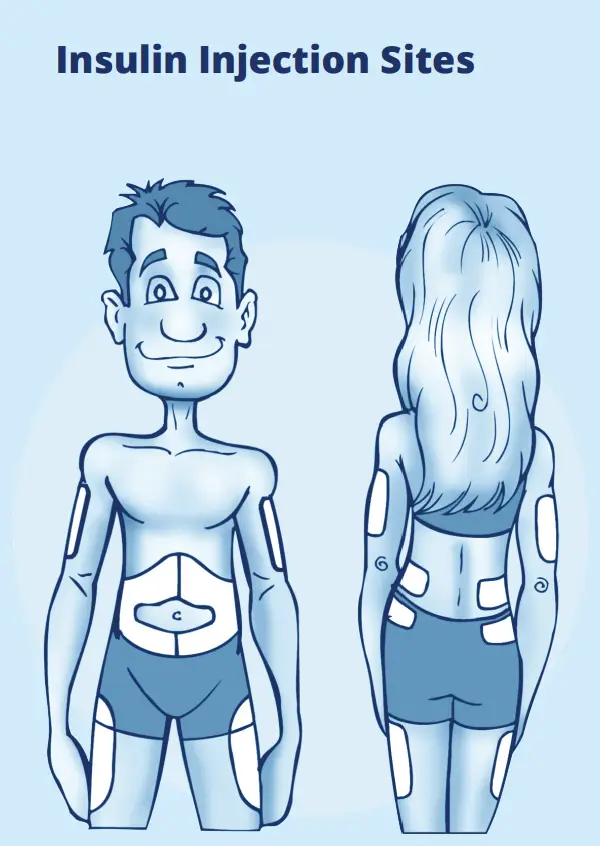
Preparing for injections
Wash hands with soap and water and be sure injection site is clean. You do not need to wipe injection area with alcohol, if you do, wait until it is fully dry before injecting. Wipe the rubber stopper (seal) on the pen or vial with alcohol before attaching a new needle. Do not wipe or clean the needle tip with alcohol.
Giving Your Injection
1. Gather your supplies.
2. Mix cloudy insulin.
3. Attach pen tip or needle.
4. Check that the needle is not blocked by ‘priming’ it.
5. Dial up the dose of insulin to be taken.
6. Choose injection site.
7. Insert pen tip or needle into skin at a 90º angle with a quick smooth motion. [With longer needles (8mm or 12 mm), you may need to gently lift the skin before injecting or inject on a sharper (45º) angle.]
8. Push the dosing button until you see ‘0’ or the syringe is empty
9. Count 10 seconds before removing the tip or needle from your skin.
10. Remove and put tip/needle into safe sharps container.
NOTE: Pen tips and needles should only be used once before safely adding to a sharps container. Do not leave pen tips on the end of pen in between injections.
Mixing Insulin:
Insulin that is cloudy (intermediate, premixed) needs to be mixed so that it has a milky-white look before each use. To mix the insulin, the pen or vial should be rolled ten times between your hands and then tipped upside down and back ten times.

Checking Insulin Pen Flow (Priming your pen):
- Dial up 2 or 3 units (whichever the manufacturer recommends)
- With pen tip facing upwards, push the dosing button
- If no insulin appears, repeat up to three times
- If no insulin still, replace pen tip and try again.
Safe sharps disposal
Pen tips and lancets should be disposed of in a sharps container. Check with your local pharmacy. Many pharmacies supply safe, puncture-proof containers. When the container is full, it is returned to the pharmacy in exchange for a new container.
Tips for comfort
- Keep insulin you are using at room temperature
- Be sure to use a new tip or needle each time
- Try to use shorter needles with a smaller thickness
- Use a healthy, soft injection site
- Inject insulin slowly and evenly
- Do not inject through clothing
Types of insulin
Some insulins work fast for food, and some work slowly all day. Many people use both to keep blood sugar in range. Premixed short and long-acting insulin is also available. Speak to your healthcare provider about the type, timing and amount that you may need.
Type | What it does | When to take it | Brand |
Bolus | |||
Rapid acting analogues | Works fast to act on food eaten at meals | 0 to 15 minutes before meals, multiple times a day | Humalog®, Admelog®†, Humalog® U-200, Fiasp®, Apidra®, NovoRapid®, Trurapi®‡, Kirsty®‡ |
Short acting | 15 to 45 minutes before meals, multiple times a day | Humulin® R | |
Basal | |||
Intermediate acting (cloudy) | Works up to 16 to 24 hours for baseline blood sugar control | Most often at bedtime, usually once a day | Humulin® N |
Long-acting analogues | Lantus®, Semglee®*, Basaglar®* | ||
Ultra long analogues | Works up to 48 hours | Most often at bedtime, every other day | Tresiba® U-100, Tresiba® U-200, Toujeo® |
Once weekly analogues | Works for a week | Once a week | Awiqli® U-700 |
Premixed | |||
Premixed regular (cloudy) | Mix of fast acting and long-acting insulin to cover meals and between meals | 30 minutes before meals, one or more meals per day | Humulin® 30/70, Novolin® ge 30/70 |
Premixed analogues (cloudy) | Humalog® Mix25®, Humalog® Mix50®, NovoMix® 30 | ||
| †Biosimilar to Humalog® |‡ Biosimilar to NovoRapid® | *Biosimilar to Lantus® Analogue: An insulin analogue is insulin that’s been slightly changed so it works more like the body needs it too. Small changes help it to work faster, longer and more consistent over time. Biosimilar: A biosimilar insulin is a newer version of an existing insulin. It is made from living cells, just like the original insulin. Because it comes from living sources, it's not an exact copy — but it is very similar, works the same and often costs less. | |||
.webp?language=en)
Diabetes Identification:
Always carry a note or card in your wallet or purse that says you have diabetes. If able, bracelets and necklaces, such as MedicAlert®, can be bought at pharmacies and jewelry stores. It is important in case of emergency that others know you have diabetes.
Remember, it will take time to fine-tune your insulin routine, and it may change over time depending on life events or changes in your lifestyle. Talk to your health-care team about adjusting insulin based on your blood sugar readings, how to manage low and high blood sugar levels and any changes you may need to your insulin plan.